Pool fence repairs in Wagga: fixing a fault on a sound fence
Pool fence repairs in Wagga usually start with the gate. If a self-closing gate no longer latches, the Wagga council page says it has to stay permanently fastened until it is fixed. Do not prop it open, and keep supervising: a fence is one layer of protection, and watching the children comes first. Then get a contractor to find the fault. We are a referral service: we pass your enquiry to a local contractor, who does the repair and answers for it.
This page is for a fence that is otherwise sound. If whole runs need renewing, see replacement and upgrades. If you want the inspection and certificate pathway, see compliance and inspections.
Pool gate latch not closing: what the council page says
The council page says gates must open outwards and be fully self-closing and self-latching. A gate that has stopped latching has lost one of those, so it is a repair job, not a nuisance. The council's own policy says the gates must be kept closed at all times, and the NSW owner page says the same about the doors and gates that give access to the pool. The cause of a latch fault can sit in the latch, the hinges, the gate or the post, and finding it is the contractor's work.
This site gives no latch height or release figure. The council page also sets a minimum latch height for pool doors, and sources differ on latch figures. Read the council page and ask the contractor and certifier before a latch is replaced.
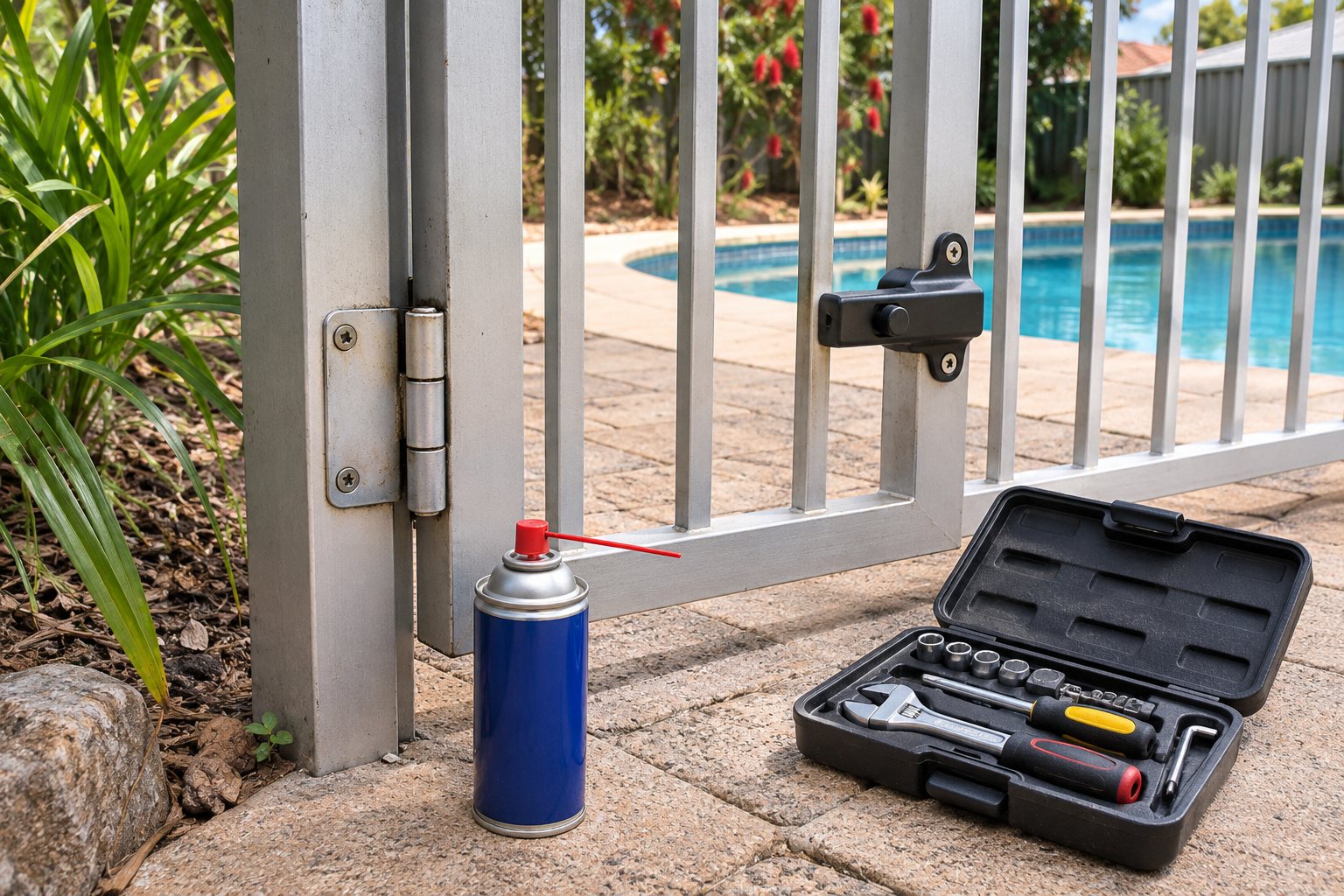
Pool gate hinge repair and the council's maintenance list
The council page lists what an owner should keep on top of. Several items are repairs in waiting:
| Item | What the sources say | What to ask the contractor |
|---|---|---|
| Fasteners | The council page lists keeping fasteners tight. | Whether any have worked loose, and whether a panel or post has moved. |
| Palings and panels | Broken palings are on the maintenance list. | Whether a broken piece is a repair or a section to replace. |
| Self-closing hinges | The list includes lubricating self-closing hinges. | Whether a gate that drags or springs back slowly needs more than lubrication. |
| Locks and latches | Locks and latches are on the same list. | Whether the latch is worn, and what the replacement must meet. |
| Gate held open | The council policy says gates must be kept closed at all times. | Why the gate does not stay shut on its own. |
| Objects near the fence | The council page says nothing should stand within 900 mm of the fence. | What the contractor sees near your fence. See the non-climbable zone page. |
| Warning sign | The NSW owner page says the sign must be easily readable from 3 m. | Whether a worn sign needs replacing. Existing signs need updating only if the barrier is substantially altered or rebuilt. |
The 900 mm figure is from the edition the council pages cite (AS 1926.1-2012), and the 3 m sign distance is the NSW owner page's own wording. A 2024 edition has been published and no NSW page we found says which edition a certifier applies to a new fence today. Ask the council or your certifier which dimensions apply to your fence before you rely on any figure here. The height, gaps and gates page explains the edition question in full.
Gates left open, and why a repair matters
Nationally, Royal Life Saving Australia's child drowning report for July 2015 to June 2025 recorded 87 children aged 0 to 4 who drowned in a swimming pool. In 36 per cent of cases, the report says, the child reached the pool because the gate had been left open, and 78 per cent of the children were not directly supervised. The report has no NSW figures, so these are national context only. That is national context only, and it is one reason to fix a gate that will not shut.
Will a repair be inspected, and does it mean a full upgrade?
A repair does not by itself book an inspection, as far as the pages we found show. Inspections happen when the council inspects under its program, follows up a complaint, or an owner asks for one, for example before a sale. If the council finds work outstanding, its policy describes a letter giving 14 days to complete it and then a re-inspection, and a re-inspection may attract an additional fee. The inspections page explains when that can happen.
The harder question is how far a repair can go. The NSW owner page says barriers modified during renovations must meet AS1926.1-2012 and previous exemptions end. The Regulation treats an existing barrier as complying if it complied with the standard that applied at the time and still does. The pages we found do not draw the line between a repair and a modification, so ask the council or your certifier before the work starts. The replacement page covers what changing a fence can trigger.
What to photograph for a repair quote
Photos let a contractor tell a latch fault from a hinge fault before a pool gate repair is quoted. Send:
- the gate closed, then open, from the pool side and from outside;
- the hinges and the latch, close up;
- any broken or loose panel or paling, and the whole run of fence either side;
- the ground at the foot of the fence;
- anything standing or growing next to the fence;
- the warning sign.
Add your suburb, roughly when the pool was built if you know, and whether a boundary fence is part of the barrier. We do not give DIY repair steps. What makes a repair acceptable is for the contractor and the council or certifier to decide.
Who does the repair, and what to ask
Licensing depends on the type and value of the work. The regulator pages we found do not say which category covers fitting or repairing a pool fence. Ask the contractor which licence or registration they hold, check it on the NSW licence check, and ask Building Commission NSW if you are unsure. Ask for the scope in writing and whether the price includes a return visit. Photos can go in through the contact page. The cost guide lists what moves a quote. If you are in Kooringal, the Kooringal page adds local housing facts.
What this page cannot do
This page cannot diagnose your gate or tell you whether a repair is enough. It cannot say whether a latch you have is acceptable, because latch figures differ between sources and the council page is the one to read. It cannot say whether your fence will pass an inspection, which edition of AS 1926.1 applies, or which licence or registration the work needs. The council, your certifier and the contractor answer those. It gives no prices and no repair steps for owners to follow.
Check the current rules before you rely on this
This page describes pool fence and gate repairs and what the Wagga council pages, the NSW Government and Royal Life Saving Australia say about maintenance. It describes the rules in general terms as they stood in November 2026. Standards, forms, thresholds and fines change.
The authoritative sources are Wagga Wagga City Council, pool fencing requirements, Wagga Wagga City Council, Swimming Pool Safety Policy POL 049 (approved 17 October 2022), Royal Life Saving Australia, child drowning report, July 2015 to June 2025 (national, no NSW figures), NSW Government, owning a pool or spa: your obligations (updated 16 March 2026) and Wagga Wagga City Council, apply for a swimming pool certificate of compliance. Where anything here differs from those sources, they are right and we are not.
We are not pool fencing contractors, certifiers, builders, regulators or lawyers. For what applies to your pool, ask Wagga Wagga City Council or your certifier which rules and which edition of the standard apply, ask the contractor which licence or registration they hold, and ask Building Commission NSW if you are unsure about licensing.
Accurate at the time of writing, November 2026. Always check the source before relying on it.